
My first stock was Tata Motors.
I do not remember exactly why I picked it. It felt like a solid company, a name I recognised, something that made sense to buy. When I saw the price move for the first time I felt everything. Happy when it went up. Sad when it went down. I checked my profit and loss screen multiple times a day like it was going to tell me something different each time.
That emotional rollercoaster is where every beginner starts when learning stock market basics. And it is also where most beginners make their worst decisions.
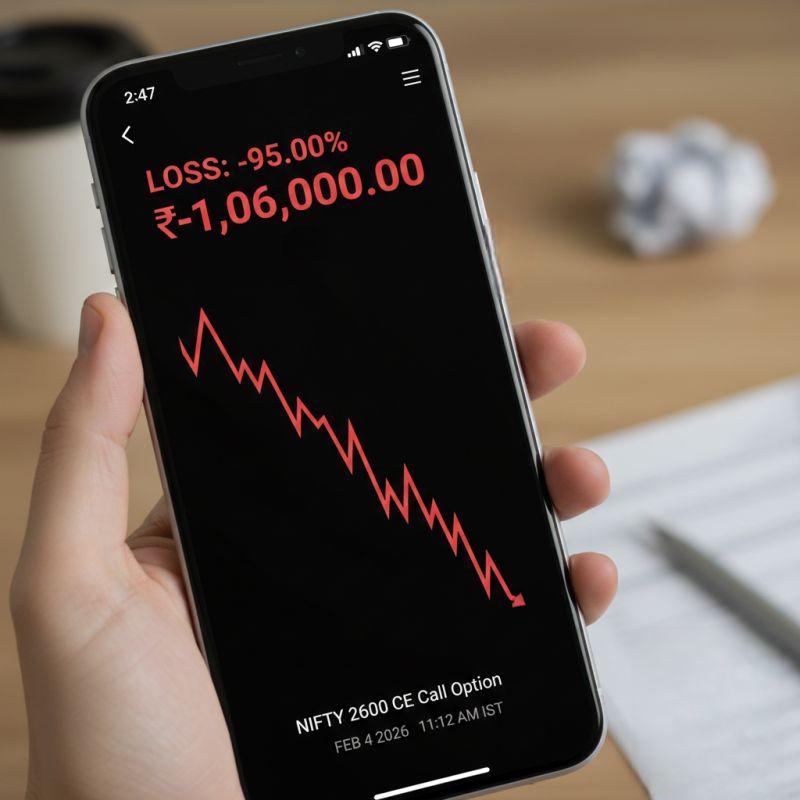
Then I lost 10,000 rupees on a single options trade. My entire capital. Gone in about an hour on a Monday morning. I held a PE option over the weekend after some analysis, expecting multiple times returns when the market opened. Instead I lost 50% the moment the market opened and held on hoping it would recover. It did not. I lost everything in the next hour.
I regretted it for a while. Now it is just a costly lesson.
This guide covers every stock market basic you need to know before placing your first trade. Not the textbook version. The honest version that nobody told me before I blew up my first account.

Stock Market Basics: What Is the Stock Market and How Does It Work in India
The stock market is a marketplace where buyers and sellers trade ownership stakes in companies. When a company wants to raise money from the public, it lists itself on a stock exchange and issues shares. Each share represents a small ownership percentage in that company. When you buy a share of Tata Motors, you own a tiny piece of Tata Motors.
Understanding this stock market basic is more important than it sounds. You are not just buying a number that moves on a screen. You are buying ownership in a real business with real employees, real revenues, and real profits or losses.
In India there are two primary stock exchanges. The National Stock Exchange, known as NSE, and the Bombay Stock Exchange, known as BSE. NSE is the larger of the two by trading volume and most retail traders in India use NSE for equity and derivatives trading. BSE is older and has more companies listed but lower daily volumes for most stocks.
Both exchanges are regulated by SEBI, the Securities and Exchange Board of India. SEBI is the watchdog that sets rules for listed companies, brokers, and investors to ensure fair and transparent markets. All legitimate brokers in India are registered with SEBI and you can verify any broker’s registration on the SEBI official website
When you buy or sell a stock through your trading platform, your order goes to the exchange where it is matched with a corresponding buyer or seller. This entire process happens electronically in milliseconds. The price you see moving on your screen is the result of millions of these buy and sell orders happening simultaneously every second the market is open.
Stock Market Basics: The Two Main Ways to Make Money
Before going deeper into stock market basics, you need to understand the two fundamental ways investors make money from stocks.
Capital appreciation means buying a stock at a lower price and selling it at a higher price later. If you bought Tata Motors at 400 rupees and sold it at 600 rupees, you made 200 rupees per share in capital appreciation. This is the most straightforward stock market basic and how most people think about making money from stocks.
Dividends are a share of the company’s profits paid directly to shareholders. Not all companies pay dividends but many established companies in India do. If you hold shares of a dividend paying company, you receive periodic cash payments simply for holding those shares. Dividend investing is a strategy focused on building a portfolio that generates regular passive income without selling your holdings.
Most beginners focus entirely on capital appreciation, trying to buy low and sell high. Long term investors often combine both approaches, holding quality companies that appreciate in value over time while also collecting dividends along the way.
Is the Stock Market Gambling: The Honest Answer
This is one of the most asked questions by anyone learning stock market basics and I want to answer it honestly because most people either say it definitely is or definitely is not, and both extremes are wrong.
I partially believe the stock market involves elements of gambling. No matter how much analysis you do or how much you prepare, the market is almost always a step ahead. When I started I did not think it was gambling at all. I thought analysis was everything. After a couple of losses I started thinking maybe analysis is completely useless and it is all just luck.
The truth I eventually arrived at is somewhere in the middle. The stock market is not entirely gambling but you definitely cannot win by analysis alone.
Here is what separates investing from gambling. In gambling, the house has a statistical edge and over enough time every gambler loses to the house. In the stock market, the long term statistical edge belongs to investors, not against them. The Indian economy has grown consistently over decades.
Corporate profits have grown. The Nifty 50 has delivered roughly 12% to 14% annual returns over the past 20 years. If you simply bought and held an index fund tracking the Nifty 50 you would have beaten most professional traders over that period.
But here is where stock market basics get uncomfortable. When you trade actively, especially in derivatives like futures and options, the short term price movements are genuinely unpredictable.
News events, global market moves, institutional activity, and pure sentiment can move a stock or index in any direction regardless of what your charts say. SEBI data has shown that over 90% of individual traders in the equity derivatives segment in India lose money over any given year.
The honest answer is this. Long term investing in quality companies or index funds is not gambling. It is participating in economic growth. Short term trading, especially in options, has enough randomness and enough structural disadvantages for retail traders that it behaves very much like gambling for most people who try it.
Stock Market Basics: Key Terms Every Beginner Must Know in 2026
Before you place a single order you need to understand the language of the market. These are the essential stock market basics in terms of vocabulary that every beginner must know.
Bull market refers to a period when stock prices are generally rising and investor sentiment is positive. When people say the market is bullish they mean prices are going up or expected to go up.
Bear market refers to a period when stock prices are generally falling, typically defined as a decline of 20% or more from recent highs. Bear markets test every investor’s patience and conviction. Every serious investor goes through at least one and how you handle it defines your long term results.
Index is a basket of selected stocks used to represent the overall market or a specific segment of it. The Nifty 50 tracks the 50 largest companies listed on NSE. The Sensex tracks 30 companies on BSE. When you hear the market went up today it usually means these indices moved up.
IPO or Initial Public Offering is when a company lists on the stock exchange for the first time, offering shares to the public. Applying for IPOs is done through your demat account using the ASBA process linked to your bank account. IPOs are one of the first things beginners get excited about and one of the first places beginners lose money chasing hype.
Market capitalisation or market cap is the total value of a company’s outstanding shares. Large cap companies have a market cap above 20,000 crore rupees. Mid cap companies fall between 5,000 and 20,000 crore. Small cap companies are below 5,000 crore. Large cap stocks are generally more stable while small cap stocks carry higher risk and higher potential returns. As a stock market basic rule, beginners should stick to large caps until they understand the game.
PE ratio or Price to Earnings ratio is a valuation measure that compares a company’s share price to its earnings per share. A high PE ratio means the market is paying a premium for the stock, often because of expected future growth. A low PE ratio can indicate undervaluation or a struggling business. Neither high nor low PE is automatically good or bad without context.
52 week high and low refers to the highest and lowest price a stock has traded at in the past 52 weeks. These levels are psychologically significant and often act as resistance or support points in technical analysis.
Circuit breaker is a mechanism that halts trading in a stock or the entire market when prices move too dramatically in a short period. An upper circuit means the stock has hit its maximum allowed gain for the day. A lower circuit means it has hit its maximum allowed loss. Small cap and mid cap stocks hit circuits far more often than large caps.
Stock Market Basics: Investing vs Trading
This distinction is one of the most important stock market basics and most beginners completely ignore it.
Investing means buying stocks or funds with the intention of holding them for years, participating in the long term growth of the company or the economy. Investors do not care about daily price movements. They care about business fundamentals, the quality of management, and where the company will be in five to ten years.
Trading means buying and selling stocks over shorter time frames, from seconds to weeks, trying to profit from price movements. Traders care about charts, patterns, volume, and momentum. They are not interested in owning a business. They are interested in the price movement of a ticker.
Both are legitimate approaches but they require completely different skills, temperaments, and time commitments. The mistake most beginners make when learning stock market basics is starting with trading, specifically options trading, because the potential returns look extraordinary.
The reality is that options trading is one of the most complex and high risk activities available in financial markets anywhere in the world. Starting there is like learning to drive by entering a Formula 1 race.
If you are a beginner, start with investing. Buy quality companies or index funds, hold them for the long term, and let compounding do the work. Learn trading only after you understand how markets work and after you have built some financial cushion that can absorb losses without derailing your life.
The Mistake That Cost Me 10,000 Rupees and What It Teaches You
I want to walk you through exactly what happened when I lost my entire options trading capital because it is a mistake thousands of Indian beginners make every single month and no amount of stock market basics education seems to prevent it.
I was holding a PE option, which is a bet that the market would go down, over a weekend. I had done analysis. I was confident. I was expecting multiple times returns on my capital when the market opened on Monday morning.
The market did not agree with my analysis. I lost 50% of my capital the moment the market opened. I held on. I told myself it would recover. It did not. Within another hour I had lost everything. 10,000 rupees. My entire capital. Gone.
I regretted it for a while. But looking back now it is just a costly lesson that taught me more about stock market basics than any book or course could have.
Here is what that single trade taught me.
Never hold options overnight and especially never over a weekend if you are a beginner. Options lose value over time due to a factor called theta decay. Over a weekend you are paying three days of time decay for one day of market exposure. The math works against you before the market even opens.
Never put all your capital in a single trade. I put my entire 10,000 rupees in one position. If I had split it across five smaller positions, losing one would not have wiped me out completely. This is the single most important risk management stock market basic there is. Never put all your eggs in one basket.
Hope is not a trading strategy. When a trade goes against you the question is not whether it will recover. The question is whether your original reason to enter that trade is still valid. If it is not, exit. Full stop.
The biggest stock market basics mistake I made was expecting unnatural returns in a very short period of time. I treated the options market as a get rich overnight scheme while completely ignoring the fact that it could cost me everything in the same night. It did.

How to Actually Start in the Indian Stock Market the Right Way in 2026
Here is the step by step process I would follow if I was starting today with the benefit of everything I have learned about stock market basics since that first trade.
Start with paper trading. Paper trading means practising with virtual money before using real money. Spend at least one to three months paper trading before you put real capital at risk. This is the step most beginners skip because it feels slow and boring. It is the most important step there is.
Open a demat and trading account with a discount broker. I started with Upstox because of its clean and easy to use interface and it served me well as a learning platform. I later moved to Zerodha when Upstox increased their brokerage charges significantly, making active trading expensive.
My honest recommendation for stock market basics beginners is to start with Upstox to learn the platform and understand how trading works, then move to Zerodha when you are comfortable or stay with Upstox if you can manage the charges. Both are SEBI registered and trustworthy.
Learn before you earn. Zerodha Varsity is completely free and covers everything from absolute stock market basics to advanced options strategies in simple language. Read it before you trade. This is not optional.
Start with equity delivery investing. Buy shares of two or three quality large cap companies that you understand and hold them for at least six months to a year. Watch how they behave, how they react to news and quarterly results, how they move during market corrections. This is your real stock market basics education playing out in real time with real money you can afford to lose.
Keep position sizes small when you start trading. When you are ready to try active trading, never risk more than 1% to 2% of your total capital on a single trade. If you have 50,000 rupees, one trade should never put more than 500 to 1000 rupees at risk. This keeps you in the game long enough to actually learn the deeper stock market basics.
Stay emotionally stable. When I started I was checking my profit and loss multiple times a day, celebrating every small gain and stressing over every small loss. That emotional involvement clouds your judgment and leads to impulsive decisions that cost money. The market is a long game. Treat it like one from day one.
Stock Market Basics: Understanding Nifty 50 and Sensex
Every day you hear that the Nifty went up 200 points or the Sensex fell 500 points. Understanding what this actually means is a core stock market basic that every beginner needs to get right early.
The Nifty 50 is an index comprising the 50 largest and most liquid companies listed on NSE across various sectors. It includes companies like Reliance Industries, HDFC Bank, Infosys, TCS, and ICICI Bank among others. When the Nifty 50 moves up it means on average the share prices of these 50 large companies increased. When it falls their prices fell on average.
The Sensex is the equivalent index on BSE tracking 30 companies. It is older and more widely quoted in mainstream media but the Nifty 50 is more commonly used by traders and investors for practical purposes.
Why does this stock market basic matter to you as a beginner? Because the simplest and most effective way to invest in the Indian stock market is to simply buy an index fund or ETF that tracks the Nifty 50. You do not need to pick individual stocks.
You do not need to analyse quarterly results. You just own a small piece of the 50 largest companies in India and grow with the Indian economy over time. This approach has beaten most active fund managers over long periods according to SPIVA India data.
Stock Market Basics: Taxes on Profits in India 2026
You cannot cover stock market basics without covering taxes. Many beginners discover this the hard way when they receive a tax notice.
Short term capital gains on equity shares sold within one year of purchase are taxed at 20%. Long term capital gains on equity shares held for more than one year are taxed at 12.5% on gains exceeding 1.25 lakh rupees per financial year. Gains below 1.25 lakh in a year are completely tax free for long term holdings.
For intraday trading, profits are treated as speculative business income and taxed at your applicable income tax slab rate which can go up to 30% plus surcharge for higher income brackets.
For futures and options trading, profits are treated as non speculative business income and taxed at your slab rate. F&O traders are also required to get a tax audit done if their turnover crosses certain thresholds.
Always file your ITR if you have stock market income. The income tax department receives transaction data directly from exchanges and brokers. Not declaring stock market income is not a risk worth taking. You can check the latest tax rates and filing requirements on the Income Tax India official website.

FAQ: Stock Market Basics India 2026
What are the stock market basics every beginner in India must know first?
The most important stock market basics are understanding what a share is, the difference between investing and trading, how the NSE and BSE work, what indices like Nifty 50 and Sensex represent, and how to open a demat account. Before putting any real money in, spend time on Zerodha Varsity which covers all stock market basics for free.
How much money do I need to start with stock market basics in India?
You can start with as little as 100 rupees. Many stocks on NSE and BSE are priced below 100 rupees per share. For SIPs in mutual funds you can start with 500 rupees per month. There is no minimum requirement to open a demat account or begin applying stock market basics in real investments.
Is the stock market safe for beginners applying stock market basics in India?
Long term equity investing in diversified funds or quality large cap stocks is relatively safe over periods of five years or more. Short term trading, especially in derivatives, carries a high risk of loss and is not suitable for anyone still learning stock market basics. Your approach determines your risk entirely.
What is the difference between NSE and BSE for stock market basics beginners?
Both are Indian stock exchanges where shares of companies are traded. NSE is larger by trading volume and most commonly used for equity and derivatives trading. BSE is older and has more companies listed. Most large companies are listed on both. For applying stock market basics as a beginner, NSE is where you will spend most of your time.
Can I lose all my money in the stock market?
In long term diversified investing, losing everything is extremely unlikely because it would require every company in your portfolio to simultaneously go bankrupt. In options trading, yes, you can lose your entire invested capital in a single trade as I learned firsthand. Risk management is not an advanced concept. It is a fundamental stock market basic.
What is the role of SEBI in the Indian stock market?
SEBI is the Securities and Exchange Board of India, the regulatory authority overseeing the Indian securities market. SEBI sets rules for listed companies, brokers, mutual funds, and investors. It investigates market manipulation and insider trading and works to protect retail investors learning stock market basics for the first time. More information is available at the SEBI official website.
Should I invest in individual stocks or mutual funds as a beginner learning stock market basics?
Mutual funds, especially index funds, are better suited for beginners still learning stock market basics. They provide instant diversification, are managed systematically, and do not require you to analyse individual companies. Individual stock picking requires significant time, knowledge, and emotional discipline that most beginners have not yet developed.