
Every Indian has a strong opinion on this topic. Your father swears by gold. Your uncle bought a flat in 2005 and has been calling himself a genius ever since. Your colleague just opened a Zerodha account and thinks everyone else is behind the times.
None of them are completely right. And none of them are completely wrong either.
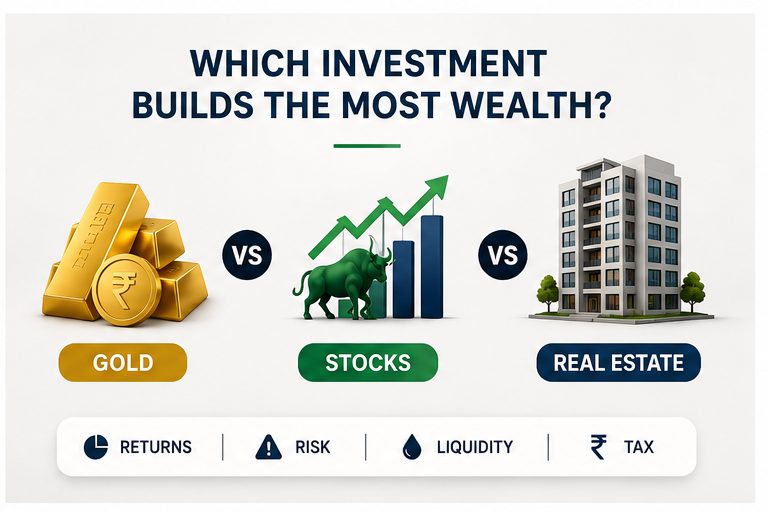
Gold vs stocks vs real estate is not a competition with one winner. All three have made people genuinely wealthy in India. All three have also destroyed wealth when people invested at the wrong time, for the wrong reasons, or with money they could not afford to lock away.
This article gives you the complete picture so you can make the right call for your own situation.

Quick Overview: Gold vs Stocks vs Real Estate India 2026
| Feature | Gold | Stocks | Real Estate |
|---|---|---|---|
| Minimum Investment | Rs 500 digital | Rs 100 SIP | Rs 20 lakh plus |
| Liquidity | High digital, low physical | Very high | Very low |
| Expected Annual Return | 10 to 13% | 13 to 15% long term | 6 to 10% after costs |
| Additional Income | 2.5% Sovereign Gold Bond | 1 to 2% dividend | 2 to 3.5% rental yield |
| Long Term Capital Gains Tax | 12.5% after 2 years | 12.5% after 1 year | 12.5% after 2 years |
| Volatility | Medium | High | Low to medium |
| Maintenance | Low digital | None | High |
| Transparency | High | High | Low to medium |
Gold in India: What It Actually Does for Your Wealth
Gold has a place in Indian culture that goes far beyond finance. It is gifted at weddings, stored in lockers, bought on Dhanteras, and treated as a symbol of security across generations. That emotional connection is real. But emotionally important and financially smart are not always the same thing.
Gold has given roughly 10 to 13 percent annual returns in Indian rupee terms over the last 20 years. On the surface that sounds excellent. But a large part of that return comes from currency depreciation rather than actual gold price growth. The rupee has weakened significantly against the dollar over the decades. Since gold is priced in dollars globally, a falling rupee automatically inflates the price of gold in India.
In real terms after adjusting for inflation, gold’s long-term returns are far more modest. It protects your wealth against inflation. It does not reliably grow your wealth well beyond that.
There are exceptional periods in the gold vs stocks debate where gold wins clearly. During 2020 gold surged sharply due to global uncertainty. Between 2008 and 2012 it doubled. But these spikes are not the norm and building an investment thesis around waiting for gold to spike is not a strategy.
The Real Job of Gold in a Portfolio
Gold’s actual role is not to make you rich. It is to not lose value when everything else is falling apart.
When equity markets crash gold typically holds its value or rises. When geopolitical tensions spike gold benefits. When central banks print money aggressively gold tends to move up. This is why financial advisors across the world recommend keeping 5 to 15 percent of your portfolio in gold as a hedge, not as your primary wealth builder.
If gold is your main investment you are using it for the wrong purpose entirely.
Physical Gold vs Sovereign Gold Bonds vs Gold ETF
Most Indians hold physical gold as jewellery, coins, or bars. Physical gold has hidden costs that silently erode your returns. Making charges on jewellery range from 8 to 25 percent. Bank locker storage costs money annually. When you sell jewellery you almost never get the full market price back.
Sovereign Gold Bonds issued by the Reserve Bank of India are a far superior option. They give you 2.5 percent annual interest on top of gold price appreciation. Zero storage cost. And if you hold them to maturity the capital gains are completely tax free. In the gold vs stocks vs real estate comparison this makes Sovereign Gold Bonds the most tax efficient of all gold options.
Gold ETFs are better than physical gold but do not offer the interest income that Sovereign Gold Bonds do.
| Form of Gold | Making Charges | Storage Cost | Capital Gains Tax | Interest |
|---|---|---|---|---|
| Physical Jewellery | 8 to 25% | Locker fees | 12.5% LTCG after 2 years | None |
| Gold Coins or Bars | 2 to 5% | Locker fees | 12.5% LTCG after 2 years | None |
| Gold ETF | 0.2 to 0.5% expense ratio | None | 12.5% LTCG after 2 years | None |
| Sovereign Gold Bond | None | None | Tax free at maturity | 2.5% per year |
Stocks in India: High Risk, High Reward When Done Right
When you look at gold vs stocks over a 15 to 20 year period in India the numbers strongly favour stocks. The Nifty 50 has delivered around 13 to 15 percent compounded annual returns over the last two decades. The Sensex has a similar record. This makes Indian equities one of the best performing asset classes available to ordinary investors in this country.
But those headline numbers hide enormous volatility and a painful gap between what the index returns and what the average retail investor actually earns.
Why Most People Underperform in Stocks
The index goes up 14 percent on average per year. Yet the average retail investor in Indian equities earns far less. Sometimes they lose money even in roaring bull markets.
The reason is behaviour. People buy when markets are at highs because everyone around them is excited. They sell when markets crash because fear takes over. They chase hot stocks based on tips from relatives or social media. They hold losing trades hoping for a recovery. They exit too early on winners.
This is not unique to India. Research from Dalbar in the US has consistently shown that investors underperform the indices they invest in purely because of poor timing decisions.
The good news is that a systematic SIP in a Nifty 50 index fund held for 10 to 15 years without interruption removes most of these behavioural traps. You automate the investing and you do not touch it during crashes.
I lost money on my very first options trade when I held a PE option over the weekend and the market reversed sharply. That loss was not because stocks are bad. It was because I was using a complex instrument without fully understanding the risk I was taking on. Starting with a simple index fund instead of options would have been a much better introduction to the stock market.
Direct Stocks vs Mutual Funds vs Index Funds
Direct stock picking requires deep research, time, and discipline that most people do not have. The majority of retail investors who try direct stocks underperform index funds over a 10 year period.
Actively managed mutual funds have mixed results. Some fund managers have beaten the Nifty 50 consistently over long periods. Many have not. The expense ratios on actively managed funds also reduce your net return meaningfully over time.
Index funds are the simplest, lowest cost, and most reliable way for most Indians to access equity returns. They have no fund manager risk and track the broader market at very low cost.
The Volatility You Must Be Prepared For
The Nifty 50 has fallen by more than 50 percent twice in the last 25 years. During the 2008 financial crisis. During the 2020 COVID crash. It has corrected by 20 to 35 percent multiple other times.
In the gold vs stocks comparison this is the biggest disadvantage stocks carry. If you cannot mentally handle seeing your portfolio drop by 30 to 40 percent without panic selling, equity will not work for you regardless of the long-term returns on paper.
The investors who build real wealth in stocks are the ones who hold through these crashes and often buy more during them.
Tax on Stocks in India
Short-term capital gains on equity held for less than one year are taxed at 20 percent. Long-term capital gains on equity held for more than one year are taxed at 12.5 percent above one lakh rupees per financial year. The more you trade the more you pay in taxes and brokerage. Long-term holding minimises your tax burden and maximises compounding.
Real Estate in India: The Beloved Asset That Is More Complicated Than It Looks
Ask any 45 year old Indian which investment made them the most money and the answer is almost always real estate. But ask them to calculate their actual returns properly and the numbers often tell a very different story.
In the gold vs stocks vs real estate debate real estate has the strongest emotional pull in India. Owning property is seen as a milestone of adulthood, a sign of stability, and a legacy for your children. These are legitimate reasons to own property. But they are not the same as it being the best financial investment in all situations.
The Hidden Costs That Kill Real Estate Returns
People say things like “I bought this flat for 30 lakhs in 2005 and it is worth 2 crores today.” On the surface that looks like roughly 10 percent annualised over 20 years.
But the full picture looks very different when you add all the costs. Stamp duty and registration at purchase add 5 to 8 percent to your cost. Brokerage on both sides of the transaction adds 1 to 2 percent. Renovation, maintenance, and society charges over 20 years accumulate to significant sums. Property tax is paid every year. If the flat sat vacant for any period you lost rental income. If you took a home loan the total interest paid over 20 years can equal or exceed the original principal amount.
When you factor everything in the actual return on many real estate investments in India lands closer to 6 to 8 percent annualised. Some properties in prime locations have genuinely delivered 10 to 12 percent and above. But the average property in a tier 2 city or a distant suburb has not always been the wealth machine people claim it is.
Rental Yield in India Is Notoriously Low
This is one of the most important points in any gold vs stocks vs real estate comparison for India. Annual rental income on residential property in most Indian cities is between 2 and 3.5 percent of the property value. That is extremely poor compared to developed markets and compared to other Indian asset classes.
A Sovereign Gold Bond gives you 2.5 percent just as interest income on top of gold price appreciation. An equity index fund potentially returns 13 to 15 percent total. When you compare rental yield against these alternatives the case for buying residential property purely as an investment becomes difficult to justify unless you bought at a significantly undervalued price.
Commercial real estate yields are better at 5 to 9 percent. And REITs listed on Indian exchanges now give ordinary investors access to commercial real estate without needing crores of capital. Embassy REIT and Mindspace REIT offer quarterly distributions with far better liquidity than any physical property.
The Liquidity Problem With Real Estate
Real estate is the least liquid asset in the gold vs stocks vs real estate comparison by a significant margin. You cannot sell a flat in a day or even a week when you need cash urgently. Finding a buyer, negotiating price, completing documentation, and getting registration done typically takes months. In a slow market it takes longer and you may have to accept a meaningful discount on price.
This illiquidity forces a kind of discipline. You cannot panic sell during a crash the way you might with stocks. But it becomes a serious problem during a genuine financial emergency when your wealth is locked in an asset you cannot quickly exit.
| Factor | Gold | Stocks | Real Estate |
|---|---|---|---|
| Entry Barrier | Very low | Very low | Very high |
| Exit Speed | Hours digital | Minutes | Months |
| Rental or Interest Income | 2.5% Sovereign Gold Bond | 1 to 2% dividend | 2 to 3.5% rental |
| Hidden Costs | Low | Low brokerage | High stamp duty, maintenance |
| Tax Advantage | Tax free Sovereign Gold Bond at maturity | ELSS 80C benefit | Section 54 rollover |
| Government Backing | Reserve Bank of India bonds | SEBI regulated | RERA regulated |
How Each Asset Behaves in Different Economic Conditions
This is the part most gold vs stocks vs real estate comparisons skip entirely. Returns do not happen in a straight line. Each asset class reacts differently to different economic environments.
During high inflation gold typically performs well as a store of value. Real estate prices also often rise because construction costs increase. Stocks have a mixed relationship with inflation. Mild inflation supports corporate earnings but very high inflation squeezes margins and pushes interest rates higher which hurts valuations.
During economic recession gold outperforms most assets. Stocks fall significantly as earnings drop and sentiment turns negative. Real estate slows down with demand falling and prices stagnating.
During strong economic growth this is where stocks outperform clearly. Corporate earnings rise, consumer spending increases, and equity markets rally hard. Gold typically lags during boom periods because investors prefer riskier assets with higher return potential. Real estate also benefits from growth but with more lag than stocks.
During currency depreciation all three asset classes tend to benefit in rupee terms. Gold benefits automatically since it is priced in dollars globally. Stocks with export revenues benefit from a weaker rupee. Real estate benefits less directly.

Tax Comparison: Gold vs Stocks vs Real Estate India
Taxes are the silent destroyer of investment returns and most people in India pay more than they need to simply because they do not understand the structure.
Long-term capital gains on equity above one lakh rupees per year are taxed at 12.5 percent after 12 months of holding. Long-term capital gains on gold are taxed at 12.5 percent after 24 months except for Sovereign Gold Bonds which are completely tax free at maturity. Long-term capital gains on real estate are taxed at 12.5 percent after 24 months without indexation benefit following recent budget changes.
The gold vs stocks vs real estate tax picture is now fairly similar across all three for long-term gains. But two areas where real estate has a genuine structural advantage are worth noting.
Section 54 of the Income Tax Act allows you to reinvest long-term capital gains from real estate into another residential property and claim an exemption from capital gains tax entirely. This rollover benefit is not available for gold or stocks. For someone actively upgrading properties over time this is a very significant advantage.
Home loan interest deduction under Section 24(b) up to two lakh rupees per year and principal repayment deduction under Section 80C also provide meaningful tax benefits for owner-occupied property that neither gold nor stocks can match.
If you want equity investment combined with tax saving, ELSS mutual funds qualify for Section 80C deduction up to 1.5 lakh rupees per year with a three-year lock-in. This is a genuine dual-purpose instrument in the gold vs stocks comparison that real estate cannot fully replicate.
For accurate and updated tax rules always refer to Income Tax India directly as these change with every budget.
Gold vs Stocks vs Real Estate: Who Should Invest Where
The right answer in the gold vs stocks vs real estate debate depends almost entirely on your life stage and financial situation.
If You Are 22 to 30 Years Old
Your biggest advantage is time. Equity compounding works most powerfully over 15 to 25 year horizons. At this stage maximising equity through SIPs in index funds makes the strongest financial sense. Adding 5 to 10 percent in Sovereign Gold Bonds as a hedge is sensible. Real estate is typically beyond comfortable reach at this age without significant parental support and taking on heavy home loan debt at 22 is rarely the best use of your capital.
If you can buy property in a genuinely good location at a reasonable price without financially stretching yourself there is nothing wrong with it. But do not take on crippling debt just because society expects you to own a flat by 25.
If You Are 30 to 45 Years Old
This is the peak earning and wealth-building phase for most Indians. A diversified approach across all three asset classes makes sense here. Equity should still be the core of your long-term portfolio. If buying a home for actual use is viable without wrecking your savings rate it is a reasonable decision that combines utility with investment. Increasing gold allocation to 10 to 15 percent as you accumulate more wealth gives you a meaningful buffer against market uncertainty.
If You Are 45 and Above
Capital preservation starts to matter more than aggressive growth. Real estate you already own provides stability and utility. Gold allocation can increase further as a portfolio anchor. Equity allocation can gradually shift toward dividend-paying stocks and debt mutual funds that provide more predictable income as you approach retirement.
Common Myths in the Gold vs Stocks vs Real Estate Debate
Real estate always goes up in India. It does not. Property in many locations has been flat or negative in real terms for years. NOIDA saw significant price corrections. Many second-home markets outside metros have stagnated for a decade. Buying at inflated prices in a poor location on blind faith that property never falls is a very costly mistake.
Gold is the safest investment. Gold is a hedge and a store of value. It is not a growth asset and it is not immune to price cycles. Anyone who bought gold at the 2012 peak and sold in 2015 lost money. Safety is relative in every asset class.
Stocks are just gambling. Speculative trading in individual stocks or derivatives without knowledge is closer to gambling. But a systematic SIP in a diversified Nifty 50 index fund held for 10 or more years is one of the most reliable wealth-building tools available to ordinary Indians today. The instrument is not the problem. The behaviour around it is.
You need crores to invest in real estate. REITs and fractional real estate platforms have changed this significantly. You can now access commercial real estate exposure with far less capital than owning physical property.
Physical gold is better because you can hold it. A Sovereign Gold Bond gives you everything physical gold gives you plus 2.5 percent annual interest plus tax-free capital gains at maturity. The only valid reason to prefer physical gold over Sovereign Gold Bonds is if you need it for actual jewellery use or wedding purposes.
The Diversification Argument: You Do Not Have to Pick Just One
The best investment strategy in the gold vs stocks vs real estate debate is not picking a single winner. It is building a portfolio that uses each asset for what it is genuinely good at.
Equity for long-term wealth creation. Gold as a portfolio hedge and inflation protection. Real estate for stability, utility, and the Section 54 tax rollover benefit when the numbers make sense.
SEBI has consistently emphasised diversification as a core principle of long-term wealth management through its investor education initiatives. The reason is simple. You cannot reliably predict which asset class will outperform in any given decade. Spreading across multiple assets reduces the risk of a single bad call destroying years of savings.
AMFI India publishes regular data on mutual fund performance across categories that can help you see how equity has actually performed versus common perceptions.
The mistake most Indian investors make is not over-diversifying. It is over-concentrating in one asset, usually property or gold, because of cultural familiarity, and missing out on the compounding power of equity over long time horizons.
Visit SEBI Investor Education and AMFI India for independent and reliable financial education resources.
Final Verdict: Gold vs Stocks vs Real Estate India 2026
| Category | Winner |
|---|---|
| Long-term wealth creation | Stocks |
| Portfolio hedge and stability | Gold |
| Tax-free returns | Sovereign Gold Bond at maturity |
| Utility and lifestyle value | Real Estate |
| Liquidity | Stocks |
| Lowest entry barrier | Stocks or Gold |
| Best tax rollover benefit | Real Estate Section 54 |
| Best for all life stages combined | Diversified mix of all three |
There is no single winner in the gold vs stocks vs real estate comparison for every person in every situation. But with what you now know you have everything you need to build a portfolio that actually works for your life stage, income, and financial goals.
For any investment decision involving significant capital always consult a SEBI-registered investment advisor who understands your complete financial picture.

FAQ: Gold vs Stocks vs Real Estate India 2026
Which gives better long-term returns in India, gold vs stocks?
Over periods of 15 years and above equity through diversified index funds has consistently outperformed gold in India. The Nifty 50 has delivered roughly 13 to 15 percent annualised returns over two decades. Gold has delivered 10 to 13 percent with a significant portion of that being rupee depreciation rather than real price growth. In the gold vs stocks comparison for long-term wealth creation stocks win clearly.
Is real estate still a good investment in India in 2026?
It depends heavily on location, entry price, and your financial situation. Real estate in prime urban corridors with strong infrastructure has done well historically. But rental yields across India remain very low at 2 to 3.5 percent and hidden costs erode returns significantly. For pure investment return on capital, equity and Sovereign Gold Bonds often beat residential real estate on a risk-adjusted basis.
What is the best form of gold investment in India?
Sovereign Gold Bonds are the best form of gold investment for most Indians in 2026. They offer gold price appreciation plus 2.5 percent annual interest plus completely tax-free capital gains at maturity. Gold ETFs are the second best option. Physical gold in the form of jewellery has the highest costs and lowest actual returns of all gold investment options.
What is the ideal portfolio split between gold vs stocks vs real estate?
A common starting framework for a working adult is 60 to 70 percent in equity for long-term growth, 10 to 15 percent in gold as a hedge, and real estate when it makes practical and financial sense for actual use. This is not a universal rule and should be adjusted based on age, income, risk tolerance, and specific goals.
Can you invest in real estate without buying physical property in India?
Yes. REITs listed on Indian stock exchanges like Embassy REIT and Mindspace REIT give you exposure to commercial real estate with regular distributions and much better liquidity than physical property. Fractional real estate investment platforms also exist for those who want partial ownership of commercial assets at lower capital commitment.
How is gold taxed compared to stocks in India?
Long-term capital gains on both gold and stocks are currently taxed at 12.5 percent. For stocks the holding period qualifying for long-term treatment is 12 months. For gold it is 24 months. Sovereign Gold Bonds are a special exception and are completely tax-free at maturity making them the most tax-efficient gold instrument in the gold vs stocks tax comparison.
Is buying a house better than investing in stocks in India?
If you need a home to live in and can afford it without sacrificing your long-term savings rate, buying makes strong practical sense as it combines utility with an asset. If you are buying a second property purely as a financial investment, stocks in most scenarios deliver better returns with far greater liquidity, no maintenance burden, and a much lower entry barrier.