
Every March, millions of Indians scramble to make last minute tax saving investments without understanding what they are actually buying. They dump money into whatever their parents used, whatever their bank recommends, or whatever their colleague mentions in a WhatsApp forward.
PPF vs NPS vs ELSS is the most important tax saving decision most working Indians will make every year. And most people make it wrong.
This article breaks down all three instruments completely. Returns, lock-in periods, tax treatment, flexibility, and exactly who should pick what based on their actual situation.
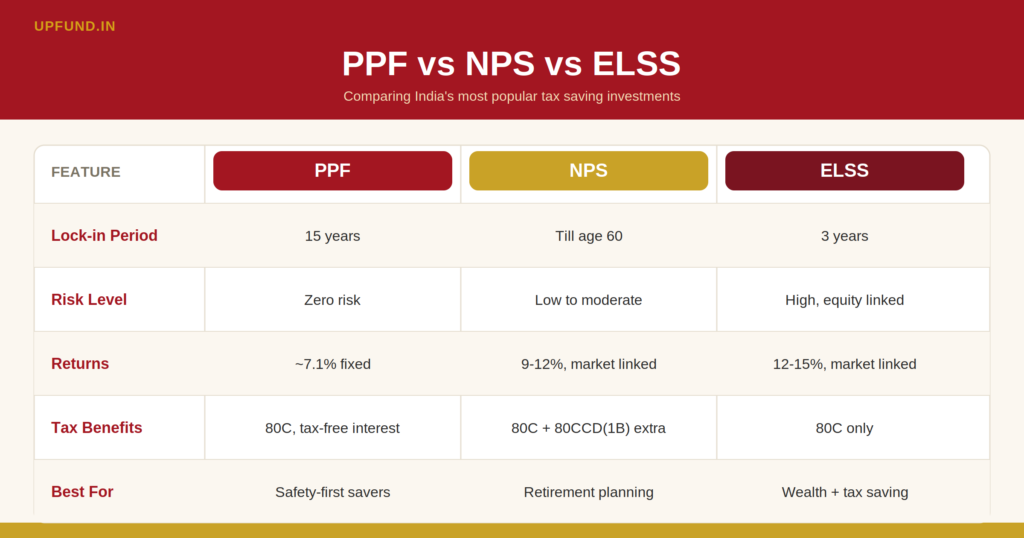
Quick Overview: PPF vs NPS vs ELSS 2026
| Feature | PPF | NPS | ELSS |
|---|---|---|---|
| Full Form | Public Provident Fund | National Pension System | Equity Linked Savings Scheme |
| Section 80C Limit | Rs 1.5 lakh per year | Rs 1.5 lakh plus Rs 50,000 extra | Rs 1.5 lakh per year |
| Lock-in Period | 15 years | Till age 60 | 3 years |
| Expected Returns | 7.1% fixed currently | 9 to 12% market linked | 12 to 15% market linked |
| Risk Level | Zero | Low to medium | Medium to high |
| Tax on Returns | Completely tax free | Partially taxable at withdrawal | 12.5% LTCG above 1 lakh |
| Best For | Conservative investors | Retirement planning | Wealth creation with tax saving |
| Liquidity | Very low | Extremely low | Lowest lock-in among three |
What Is PPF and How Does It Work
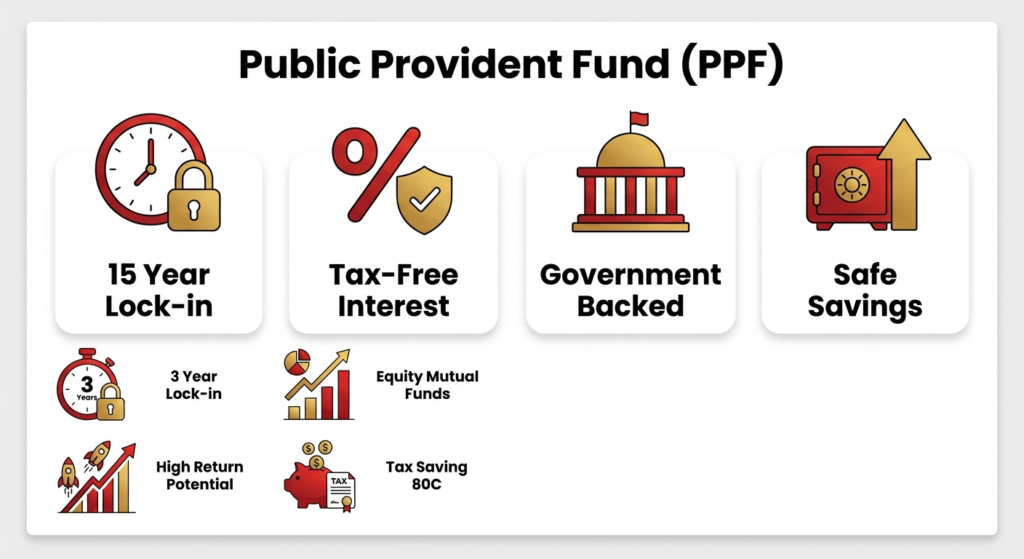
PPF or Public Provident Fund is a government backed savings scheme that has been the default tax saving instrument for Indian middle class families for decades. Your parents almost certainly have a PPF account. Their parents probably did too.
The interest rate on PPF is set by the government every quarter and is currently 7.1 percent per annum. This rate is not market linked which means it does not go up when stock markets do well and does not fall when they crash. It is a fixed guaranteed return backed by the Government of India.
You can invest a minimum of 500 rupees and a maximum of 1.5 lakh rupees per financial year in a PPF account. The contributions qualify for deduction under Section 80C up to 1.5 lakh rupees per year. The interest earned is completely tax free. And the maturity amount at the end of 15 years is also completely tax free.
This is what makes PPF an EEE instrument. Exempt at investment, exempt on interest earned, exempt at maturity. No other mainstream investment in India gives you all three.
The problem is the lock-in. 15 years is a very long time. You cannot withdraw the full amount before maturity. Partial withdrawals are allowed from the 7th year onwards but they are limited and come with conditions. Loans against PPF balance are available from the 3rd year but again with restrictions.
If you are 25 years old and open a PPF account today, your money is locked until you are 40. That is the tradeoff you are making for guaranteed, tax free returns.
PPF Interest Rate History
The PPF interest rate has actually come down significantly over the last two decades. In the early 2000s PPF offered rates as high as 11 to 12 percent. Today it sits at 7.1 percent and has been largely stagnant since 2020.
This matters when you are comparing PPF vs NPS vs ELSS over long periods. A 7.1 percent return sounds decent in isolation. But against equity instruments that have historically delivered 12 to 15 percent over 15 plus year periods, the gap in actual wealth created is enormous due to the compounding effect.
A one lakh rupee investment at 7.1 percent for 15 years becomes approximately 2.8 lakh rupees. The same amount at 12 percent for 15 years becomes approximately 5.47 lakh rupees. That difference is not small. It is nearly double the wealth.
Who Should Actually Choose PPF
PPF makes the most sense for people who want guaranteed returns with zero risk, people close to retirement who cannot afford volatility, people in higher tax brackets who benefit most from the EEE structure, and anyone who genuinely cannot sleep at night knowing their money is in the market.
For a young person in their 20s with a 15 to 20 year horizon, putting everything into PPF is leaving a significant amount of wealth on the table. The right use of PPF for a young investor is as a small guaranteed component of a larger diversified portfolio, not as the primary wealth creation vehicle.
What Is NPS and How Does It Work
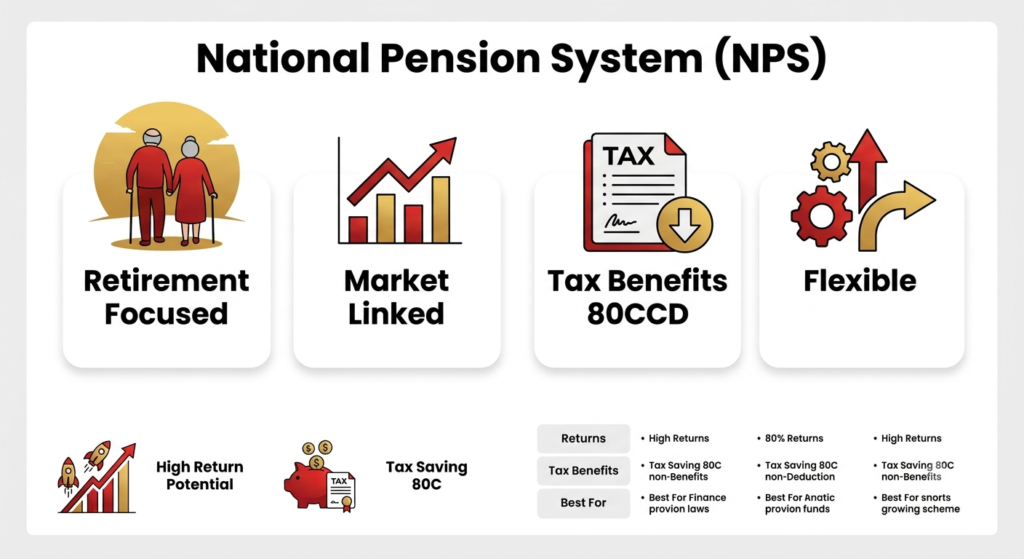
NPS or National Pension System is a government regulated retirement savings scheme that invests your money in a mix of equity, corporate bonds, and government securities. Unlike PPF it is market linked which means your returns depend on where markets go.
NPS was originally only for government employees but was opened to all Indian citizens in 2009. It is regulated by PFRDA, the Pension Fund Regulatory and Development Authority of India.
The biggest tax advantage NPS offers in the PPF vs NPS vs ELSS comparison is the additional Rs 50,000 deduction under Section 80CCD(1B) over and above the standard 1.5 lakh Section 80C limit. This means if you have already exhausted your 80C limit with other investments, you can still get an additional deduction of 50,000 rupees by investing in NPS. For someone in the 30 percent tax bracket that saves an additional 15,000 rupees in tax every year.
NPS has two account types. Tier 1 is the primary pension account with the tax benefits and the strict lock-in until age 60. Tier 2 is a voluntary savings account with no tax benefits and no lock-in, essentially just a flexible investment account with low fund management costs.
NPS Returns: What You Can Actually Expect
NPS returns depend on the asset allocation you choose. The scheme offers four asset classes. Equity (E), Corporate Bonds (C), Government Securities (G), and Alternative Assets (A).
Under the auto choice lifecycle fund, your equity allocation automatically reduces as you age. Under active choice, you can allocate up to 75 percent in equity if you are under 50 years old.
Historically the equity component of NPS has delivered returns in the range of 10 to 14 percent over the last decade. The debt components have delivered 8 to 10 percent. Blended returns for a moderately aggressive NPS portfolio typically land around 9 to 12 percent depending on market conditions and asset allocation choices.
This puts NPS comfortably ahead of PPF in expected returns over long periods, though with more volatility along the way.
The NPS Withdrawal Problem
This is the most important thing to understand about NPS before you compare it to PPF vs NPS vs ELSS alternatives. The lock-in is not just long. It is almost permanent until retirement.
At maturity when you reach age 60, you cannot withdraw the entire corpus as a lump sum. You must compulsorily use at least 40 percent of your NPS corpus to buy an annuity, which is a pension product that pays you a regular monthly income. Only 60 percent can be withdrawn as a lump sum and that 60 percent is tax free. The 40 percent annuity purchase amount is tax free at the time of purchase but the monthly pension income you receive from the annuity is taxed at your applicable income tax slab rate.
Annuity rates in India are currently very poor. They range from 5 to 6.5 percent per annum on the corpus used to purchase. This means 40 percent of your hard earned retirement corpus will effectively earn a mediocre return and be taxed as income in retirement. This significantly reduces the actual effective return of NPS compared to what the raw numbers suggest.
Premature exit from NPS before age 60 is even more restrictive. If you withdraw before 60 you must use 80 percent of the corpus to buy an annuity and only 20 percent can be taken as a lump sum. This makes NPS one of the most illiquid investments available to Indian investors.
Who Should Actually Choose NPS
NPS makes the most sense for people in high income tax brackets who want the extra 50,000 rupee deduction under 80CCD(1B) on top of their 80C investments, salaried professionals whose employers contribute to NPS under the corporate NPS model where the employer contribution of up to 10 percent of salary is additionally tax free, and people who genuinely need forced retirement savings and worry they will spend the money if it is accessible.
For young investors in their 20s, tying up money in NPS until age 60 is an extremely long commitment. A 25 year old locking money into NPS today cannot touch it freely for 35 years. The inflexibility and the compulsory annuity requirement at maturity make NPS a poor primary investment for anyone who wants flexibility or who already has discipline around retirement savings.
What Is ELSS and How Does It Work
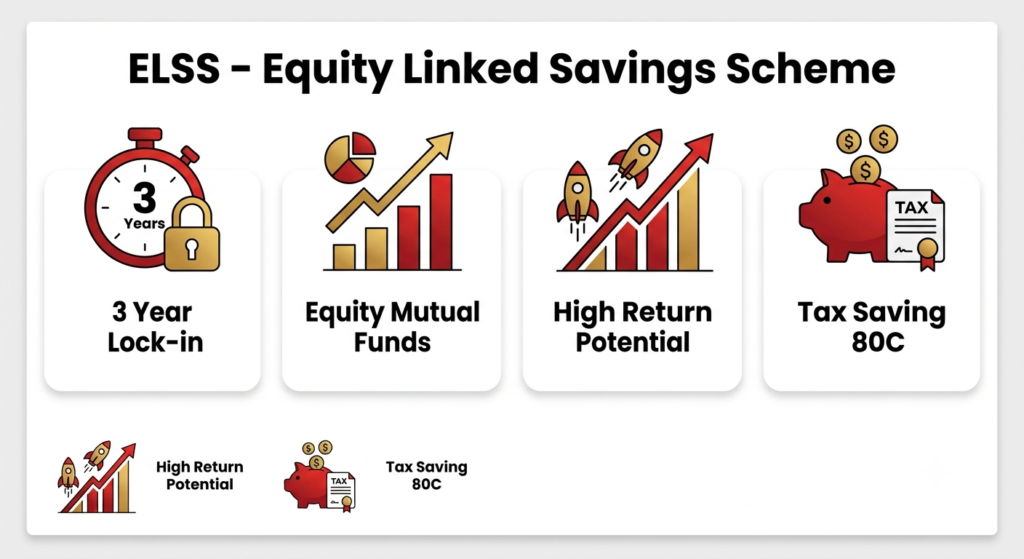
ELSS or Equity Linked Savings Scheme is a category of mutual funds that invests primarily in equities and qualifies for Section 80C deduction up to 1.5 lakh rupees per year. It has a mandatory lock-in period of 3 years which is the shortest lock-in among all Section 80C instruments.
In the PPF vs NPS vs ELSS comparison, ELSS stands out as the most aggressive and the most rewarding option for long-term investors who can handle market volatility.
Because ELSS invests in equities, its returns are entirely market linked. Over 10 to 15 year periods top performing ELSS funds have delivered 13 to 18 percent annualised returns. Even average performing ELSS funds have typically beaten PPF and matched or beaten NPS blended returns over similar horizons.
You can invest in ELSS through a lump sum or a monthly SIP. A SIP into ELSS is particularly powerful because it averages out your purchase cost over time and the 3 year lock-in applies to each individual SIP instalment from the date of that investment.
ELSS Returns: The Real Numbers
The Nifty 500 TRI which most diversified ELSS funds benchmark against has delivered approximately 14 to 16 percent annualised returns over the last 15 years. Many ELSS funds have delivered in this range or slightly above through active stock selection.
Compare this to PPF at 7.1 percent and NPS blended at 9 to 12 percent and the return differential over a 15 year period is substantial. One lakh rupees in ELSS at 14 percent for 15 years becomes approximately 7.1 lakh rupees. The same in PPF at 7.1 percent becomes 2.8 lakh rupees. That is the power of equity compounding working in your favour.
The caveat is volatility. In any given year ELSS can fall by 30 to 40 percent during market crashes. The 2008 crash wiped out nearly half the value of equity funds. The 2020 crash dropped most equity funds by 30 to 35 percent in weeks. But both times markets recovered and went to new highs within 2 to 3 years, and long-term investors who held through the crashes came out significantly ahead.
ELSS Tax Treatment
After the 3 year lock-in, any gains above 1 lakh rupees per financial year are taxed at 12.5 percent as long-term capital gains. This is the same tax treatment as any equity mutual fund held for more than one year.
The tax on ELSS gains at maturity makes it an EEE instrument at entry (80C deduction), but not fully exempt at exit the way PPF is. However the significantly higher returns even after accounting for the 12.5 percent LTCG tax typically result in more actual rupees in your pocket compared to PPF after 15 years.
Who Should Actually Choose ELSS
ELSS is the best choice in the PPF vs NPS vs ELSS comparison for anyone with a time horizon of 5 years or more who can handle market volatility, young salaried professionals in their 20s and early 30s who are making their first tax saving investments, people who want the shortest possible lock-in among 80C options to maintain some flexibility, and investors who already have other stable instruments like EPF or PPF and want their 80C investment to work harder.
ELSS is not suitable for people within 3 to 5 years of needing the money, people who will panic sell during a market crash, or people with zero risk tolerance who cannot mentally handle seeing their portfolio fall by 30 percent on paper.
Head to Head: PPF vs NPS vs ELSS on Every Parameter
Returns Comparison
Over a 15 year period starting with one lakh rupees invested per year:
| Instrument | Expected Rate | Approximate Corpus After 15 Years |
|---|---|---|
| PPF | 7.1% | Rs 25.5 lakh |
| NPS Moderate | 10% blended | Rs 31.7 lakh |
| ELSS | 13% | Rs 40.4 lakh |
These are approximate calculations for illustration. Actual returns will vary based on market conditions and fund selection. The gap however is real and compounds significantly over longer periods.
Lock-in and Liquidity Comparison
PPF locks your money for 15 years with limited partial withdrawal from year 7. NPS locks your money until age 60 with extremely restricted exit options. ELSS locks your money for 3 years per instalment after which you are free to redeem or stay invested.
In the PPF vs NPS vs ELSS liquidity comparison ELSS wins by a significant margin. The 3 year lock-in is long enough to enforce discipline and capture the equity growth cycle but short enough that you are not completely locked out of your money for decades.
Tax Benefit Comparison
All three qualify for Section 80C deduction up to 1.5 lakh rupees per year. NPS additionally offers 50,000 rupees under Section 80CCD(1B). PPF and ELSS do not have this additional benefit.
At withdrawal PPF is completely tax free. ELSS has 12.5 percent LTCG tax above one lakh rupees per year. NPS has a partially taxable structure where the annuity income is taxed at your slab rate in retirement.
For someone purely optimising for tax saving at the time of investment, the combination of 80C plus 80CCD(1B) through ELSS plus NPS gives the maximum possible deduction under current tax rules.
Risk Comparison
PPF carries zero investment risk. Your principal is guaranteed and your return is fixed by the government. NPS carries low to moderate risk depending on your asset allocation as it has debt components that stabilise returns. ELSS carries the highest risk as it is fully equity and can see significant short-term losses.
Risk in this context however must be paired with the time horizon. For a 25 year old with a 15 to 20 year horizon the risk of ELSS is significantly mitigated by time. The risk of PPF for the same person is not investment risk but opportunity cost risk, the risk of earning significantly less than you could have over 15 years.
The Smart Strategy: PPF vs NPS vs ELSS Does Not Have to Be a Single Choice
The most effective tax saving strategy in the PPF vs NPS vs ELSS debate is not picking one winner. It is using all three for what each does best.
A practical framework for a 25 to 35 year old salaried professional in India looks like this. Put the majority of your 80C allocation into ELSS for maximum return potential. Add NPS contribution of 50,000 rupees per year specifically to capture the additional 80CCD(1B) deduction which no other instrument can give you. Keep a small PPF allocation if you want a completely risk free guaranteed component in your portfolio or if your employer does not contribute to EPF.
This approach maximises your tax saving, optimises returns across risk levels, and keeps some allocation in guaranteed instruments without over committing to the extreme lock-ins of PPF and NPS for your primary wealth.
For anyone whose employer already contributes to EPF and whose EPF contribution is already exhausting or nearly exhausting the 80C limit, ELSS and NPS become the natural next steps in the PPF vs NPS vs ELSS selection process.
Always verify current tax rules and deduction limits at Income Tax India as these change with each Union Budget. SEBI regulates ELSS mutual funds and publishes useful investor education material at SEBI Investor Education. PFRDA regulates NPS and you can find official information at their website.
Common Mistakes People Make in PPF vs NPS vs ELSS Decisions
Investing in PPF only because parents did. The PPF interest rate has fallen significantly from the double digit rates your parents enjoyed. What worked for them at 11 percent does not work the same way at 7.1 percent when inflation is running at 5 to 6 percent.
Avoiding ELSS because of fear of markets. A 3 year lock-in paired with equity mutual fund investing is one of the most sensible structures available in Indian personal finance. The lock-in actually protects you from panic selling during short-term dips which is the main thing that destroys retail investor returns.
Locking everything into NPS without reading the withdrawal rules. The compulsory annuity requirement at maturity catches many people by surprise in retirement. Understand what you are signing up for before committing large sums to NPS.
Treating the 80C limit as a target to hit rather than a tool to use intelligently. The 1.5 lakh Section 80C limit is a ceiling on deduction, not an investment mandate. The instrument you choose to fill that limit matters enormously for your long-term wealth.
Waiting until March to make tax saving investments. March investments in ELSS often happen at elevated market prices because everyone is buying at the same time. A monthly SIP started in April at the beginning of the financial year averages out your cost across the full year and is almost always a better approach.
PPF vs NPS vs ELSS: Final Verdict by Life Stage
| Life Stage | Recommended Approach |
|---|---|
| First job, 22 to 25 years | Primarily ELSS for 80C, add NPS 50k for extra deduction |
| Mid career, 25 to 35 years | ELSS plus NPS combination, small PPF if EPF not available |
| 35 to 45 years | Balanced approach, increase NPS as retirement nears |
| 45 to 55 years | More PPF and NPS, reduce ELSS allocation gradually |
| Above 55 years | Primarily PPF and NPS debt allocation, minimal ELSS |
There is no single winner in the PPF vs NPS vs ELSS comparison. The right answer depends entirely on your age, income, tax bracket, risk tolerance, and financial goals. What does not work is choosing one without understanding what you are giving up by not choosing the others.
For personalised advice on PPF vs NPS vs ELSS allocation based on your specific income and tax situation, consult a SEBI registered investment advisor.
FAQ: PPF vs NPS vs ELSS India 2026
Which is better for tax saving in India, PPF vs NPS vs ELSS?
There is no single best answer in the PPF vs NPS vs ELSS comparison. ELSS gives the highest return potential with the shortest lock-in. PPF gives guaranteed tax free returns with zero risk. NPS gives an additional 50,000 rupee deduction beyond the 80C limit. For most young investors ELSS is the most efficient starting point and NPS is the best way to get the additional 50,000 deduction on top.
Can I invest in all three, PPF, NPS, and ELSS simultaneously?
Yes absolutely. You can split your investments across all three instruments. The 80C deduction is capped at 1.5 lakh rupees total across all qualifying instruments combined. But NPS additionally offers 50,000 rupees under 80CCD(1B) which is over and above the 80C limit. So theoretically you can claim up to 2 lakh rupees in deductions using a combination of 80C instruments plus NPS.
What happens to my PPF account if I need money before 15 years?
PPF allows partial withdrawals from the 7th financial year onwards. The amount you can withdraw is limited to 50 percent of the balance at the end of the 4th year preceding the withdrawal year or 50 percent of the balance at the end of the preceding year, whichever is lower. You can also take a loan against your PPF balance from the 3rd to the 6th year. Full premature closure is only allowed in specific circumstances like life threatening medical conditions or for higher education.
Is NPS safe in India?
NPS is regulated by PFRDA and is one of the safest long-term retirement instruments in India. The equity component carries market risk but the overall structure with its debt allocation provides significant stability. Your money is managed by SEBI registered pension fund managers. The risk in NPS is market risk on the equity portion, not counterparty or default risk.
What is the minimum investment in ELSS per month?
Most ELSS mutual funds allow SIP investments starting from as low as 500 rupees per month. Some fund houses have even lower minimums. For the maximum Section 80C benefit you need to invest 1.5 lakh rupees per financial year which works out to 12,500 rupees per month through a SIP.
Is ELSS better than PPF for a 25 year old?
For a 25 year old with a time horizon of 10 years or more, ELSS has historically delivered significantly better returns than PPF. The key difference is risk and lock-in. ELSS has market risk and a 3 year lock-in. PPF has zero risk and a 15 year lock-in. For someone young with stable income who can ride out market volatility, ELSS is almost always the better wealth creation choice compared to PPF.
Which ELSS fund should I invest in for 80C in India?
SEBI regulates all ELSS mutual funds and you can find the complete list on the AMFI India website. Look for funds with consistent 5 to 10 year track records, reasonable expense ratios below 1 percent for direct plans, and fund houses with strong research teams. Avoid chasing the top performer from last year as past performance does not guarantee future returns. A well established diversified ELSS fund from a reputed fund house is almost always a better choice than a concentrated or thematic ELSS fund.